Fragmented Talent and Holistic Development
📋 TL;DR — Table of Contents
- What this article is about: An analysis of the phenomenon of fragmented talent — outstanding ability in one area accompanied by failures in others — and why harmonious development is more important than narrow genius.

1. Description of the Phenomenon of Fragmented Talent
Fragmented talent is the phenomenon of sharply asymmetric development of mental functions, where a person demonstrates outstanding ability in one narrow area but simultaneously possesses weakness, underdevelopment, or pathological deficits in other spheres.
In neuropsychology, this is often associated with uncontrolled hyper-specialization of neural networks: certain areas of the cortex receive excessive training and strengthening, while other regions remain weakly integrated or develop with delay.
A strong "island" of talent coexists with "gaps" in adaptability — everyday, social, communicative, emotional, organizational.
This phenomenon can be observed in:
- individual theoretical mathematicians,
- virtuoso musicians,
- chess grandmasters,
- self-taught programmers,
- people on the autistic spectrum,
- individuals with savant syndrome.
📋 TL;DR — Description of the Phenomenon of Fragmented Talent
- Fragmented talent: A sharp asymmetry of development — outstanding ability in one narrow sphere (mathematics, music, chess) coexists with failures in everyday, social, and emotional adaptation.
2. Societal Illusions: Belief in Universal Talent
Society tends to idealize geniuses. A false premise is created:
"If they are so talented here, then they are talented in everything."
Psychology calls this the halo error.
A bright sign (genius in one area) creates a false impression about other qualities.
At the same time, many people with fragmented talent have:
- low everyday adaptability,
- communication difficulties,
- deficit in flexible thinking,
- challenges with emotional regulation,
- inability to multitask,
- narrowness of interests.
Neuropsychological research shows that with hyperdevelopment of one brain area, there is a lack of activity in other zones, which complicates correction. The brain essentially "reallocates" the resource map in favor of one domain.
These people often give the impression of a "genius in an ivory tower" who is good at one thing but chronically fails at everything else.
📋 TL;DR — Societal Illusions: Belief in Universal Talent
- Halo error: Society mistakenly transfers genius in one sphere to all others, although fragmented talent is often accompanied by everyday and social incompetence.
3. The Adequate Path of Development: A Flexible, Versatile Personality
Holistic development creates a personality capable of:
- relying on broad horizons,
- using diverse skills,
- adapting to changes,
- quickly retraining when necessary,
- balancedly combining intellect, emotions, and will.
Psychology calls this cognitive flexibility and multiple modalities of intelligence.
Such a personality is not "locked" in one sphere but is able to vary behavioral strategies according to the task.
From the perspective of neuroscience, versatile development:
- strengthens more neural networks,
- creates a wide spectrum of inter-regional connections,
- improves skill transfer,
- reduces the risk of emotional and cognitive breakdowns,
- promotes stress resilience.
A person can then "thaw" a once-learned skill, quickly regain competence, or master a completely new area — thanks to developed brain plasticity.
📋 TL;DR — The Adequate Path of Development: A Flexible, Versatile Personality
- Harmonious development: Creates cognitive flexibility, neuroplasticity, and stress resilience — unlike a "pyramid on a single pillar," where talent is hypertrophied but the foundation is missing.
4. Logical Defect of Fragmented Talent: Liebig's Barrel Paradox
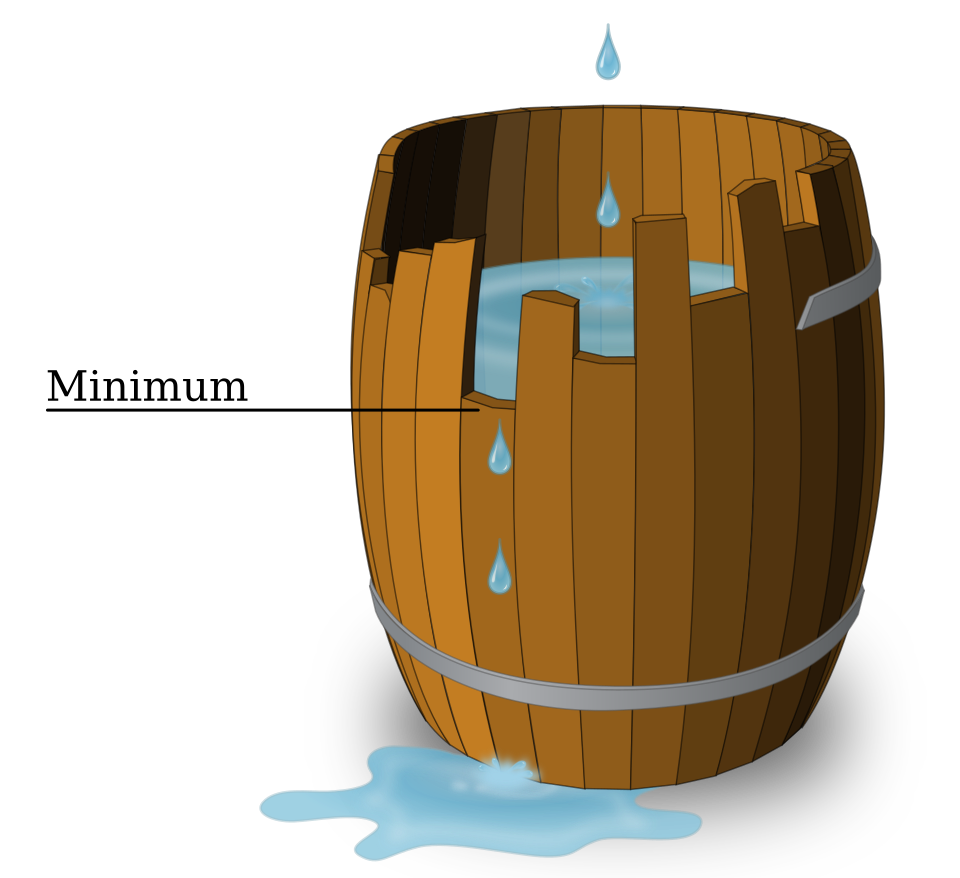
Liebig's law of the minimum states:
The efficiency of a system is determined not by its strongest element, but by its weakest.
If a person is incredibly strong in higher mathematics but completely unable to navigate everyday situations — their overall life effectiveness will be low.
Genius in one area does not offset critical failures in another.
Moreover, such failures often devalue outstanding achievements.
In psychology, this is called asynchronous development: one module is super-developed, others remain immature.
📋 TL;DR — Logical Defect of Fragmented Talent: Liebig's Barrel Paradox
- Liebig's principle: Effectiveness is determined by the weakest link. Genius in one area does not compensate for critical failures in others — this is asynchronous development, not harmony.
5. Example of Liebig's Paradox from Cottage Practice
One cottage owner might apply huge amounts of nitrogen fertilizer, for example ammonium nitrate, believing it will ensure a record harvest. But if they do not provide the soil with magnesium, potassium, or trace elements, then:
- the harvest will be low,
- or
- it will be large but of poor quality — watery, soft, tasteless, and unsuitable for storage.
Another cottage owner, applying significantly less nitrogen but ensuring a balance of all elements, will ultimately get a stable, high-quality, and healthy harvest.
Likewise, a person: one developed "maximum" does not compensate for the damage caused by an unaddressed "minimum."
📋 TL;DR — Example of Liebig's Paradox from Cottage Practice
- Fertilizer analogy: Just as excess nitrogen without other elements fails to produce a quality harvest, a hypertrophied talent does not save a person from failures in other areas of life.
6. Example from Folklore: The "Pitiful Intellectual"
The folkloric image of the lousy intellectual is a caricature illustrating fragmented talent.
This is a person who can:
- quote classical literature from memory,
- write scientific articles,
- master abstract thinking,
— but at the same time:
- overpays three times for rotten apples at the market,
- fails to see obvious deception,
- cannot hammer a nail,
- does not understand the basics of everyday logic,
- is disoriented in social behavior.
Folklore satire emphasizes:
a narrow specialty without general development looks absurd and tragic.
📋 TL;DR — Example from Folklore: The "Pitiful Intellectual"
- Satirical image: A person quotes classics and writes articles but overpays for rotten apples, cannot hammer a nail, and fails to see obvious deception — a narrow specialty without general development is absurd and tragic.
7. Literary Example: Nabokov's "The Luzhin Defense"
Nabokov masterfully described fragmented talent in the image of Grandmaster Luzhin — a person whose genius chess intellect exists against a backdrop of a complete lack of psychological stability and social adaptability.
His opponent, Grandmaster Turrati, is presented as an example of a holistically developed and flexible person:
cultured, emotionally stable, socially harmonious.
When Turrati makes non-standard moves and breaks the strategy Luzhin was accustomed to for years, Luzhin's psyche cannot withstand it. He is incapable of adaptation — and this leads to a tragic ending.
This plot is an artistic illustration that talent without flexibility turns a gift into a curse.
📋 TL;DR — Literary Example: Nabokov's "The Luzhin Defense"
- Luzhin vs Turrati: Genius chess player Luzhin breaks down before the unconventional moves of the versatile Turrati. Talent without flexibility becomes a curse.
8. The Factor of Reinforcing Self-Deception
8.1 Description of the Problem
Fragmented talent is often exacerbated by a specific cognitive trap — self-deception, reinforced by self-love and comparative arrogance.
When a person achieves outstanding results in one sphere, especially an intellectual one (humanities, philosophy, mathematics, literature), they may psychologically fixate on that single area of success, using it as proof of their own completeness or superiority over others.
This creates a distorted picture of reality:
"I am a genius here — therefore, I am superior to others in other matters too."
"My weaknesses are trivialities because I think deeper than you."
At the same time, obvious failures in the spheres that ensure the normal functioning of an adult are ignored:
- a multi-year inability to maintain order in an apartment;
- refusal to perform basic household duties (cleaning, repairs, organizing space);
- lack of care for the body, leading to deteriorating health or an unattractive appearance;
- unresolved social and emotional tasks (conflicts, ruined relationships, inability to keep one's word).
Around such a person, a peculiar internal mythology can form:
"Yes, I don't clean or fix anything, but look at the volume of knowledge I possess — you're not even close."
In practice, this is a logical error of comparing incommensurable areas.
High abilities in one narrow sphere do not compensate for destructive failures in others, which are critically important for a stable, healthy, and effective life.
Because of this error, the person:
- fails to recognize their own problems,
- does not seek help and does not accept it,
- does not take steps toward development,
Due to a distorted self-assessment, the person may even perceive an attempt to help as an infringement of their genius, as if any recommendation in "simple" spheres automatically calls their value into question. A characteristic reaction of defensive arrogance arises:
"Your gymnastics are of NO interest to me whatsoever."
The paradox is that precisely for such a person — who spends entire days with books, a monitor, or in intellectual work — elementary physical activity is not just beneficial, but physiologically mandatory for maintaining health. It reduces muscle tension, regulates circulation, decreases the risks of depression, increases neuroplasticity, improves cognitive functions — that is, directly strengthens the very sphere the person is proud of.
8.2 Parable
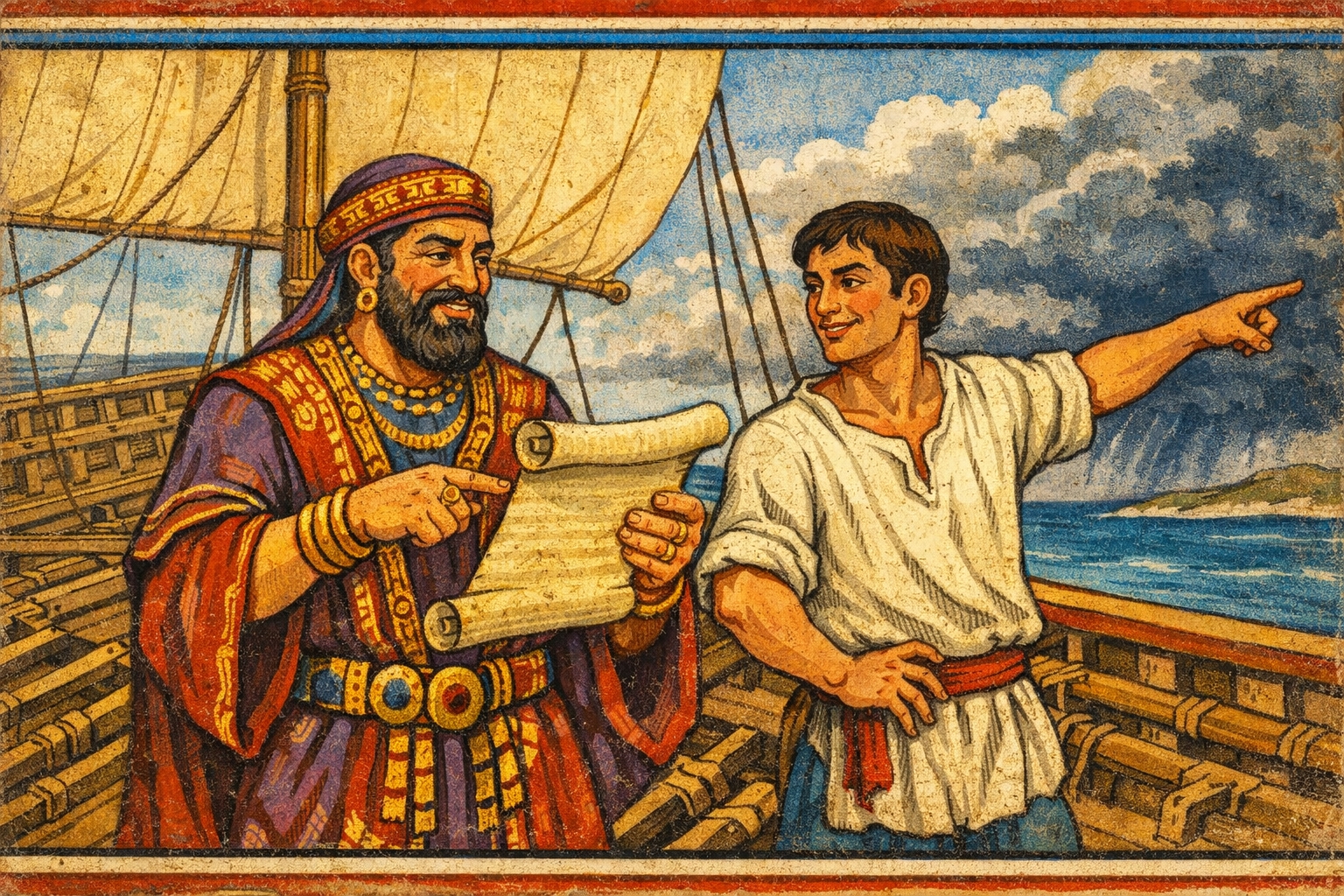
Arrogance arising on the background of fragmented talent is an ancient phenomenon, well illustrated by an old Eastern parable said to have originated in the times of the Phoenician Empire, when literacy was rare and considered a sign of elitism.
It is said that once a merchant who could read decided to mock a simple sailor. He said to him:
"If you cannot read, consider that you have lived half your life in vain."
The sailor calmly looked at the horizon and replied:
"And if you cannot swim, merchant… consider that you have lived your entire life in vain.
Because a storm is approaching us."
This parable perfectly reflects the main flaw of fragmented talent: a person tends to consider their developed skill as the measure of value for all other skills — and forgets that the world requires a complex of abilities, not one hypertrophied area.
8.3 Adequate Alternative: Equal Exchange of Competencies
A healthy, mature position sounds different:
"Yes, I am well-versed in literature/philosophy/mathematics — and I can share that.
But you are better than me at repairs, sports, rational nutrition, everyday life — teach me that."
This approach:
- breaks the fixation on a single sphere,
- reduces the risk of self-deception,
- helps the person compensate for weak areas,
- and promotes psychological maturity.
📋 TL;DR — The Factor of Reinforcing Self-Deception
- Cognitive trap: "I'm a genius here — therefore, I'm superior in everything." The person ignores failures in daily life, health, and relationships. The parable of the merchant and sailor reminds us: being able to read won't save you if you can't swim. The adequate alternative — an equal exchange of competencies.
9. Example of a Holistically Developed Personality:
9.1. Eduard Asadov
Eduard Asadov is an example of a personality developed not according to a "fragmented" but a harmonious type.
He combined:
- artistic talent,
- incredible emotional depth,
- physical courage,
- survival skills,
- discipline,
- fortitude,
- civic responsibility.
His injury in Sevastopol (a shrapnel wound that shattered his face; delivering a truck with ammunition to the position while semi-conscious) is a symbol of strength of character.
His poetry is a symbol of subtlety of feeling.
His biography is a symbol of versatility.
Some critics of "The Island of Romance" criticized it for utopianism, claiming: "such things don't exist."
But a person who lives with courage and creates beauty simultaneously has the moral right to speak of ideals: they have proven in practice that a person can be simultaneously strong and sensitive, courageous and tender.
9.2 Aleister Crowley
Despite a controversial reputation and a deliberately provocative image, Aleister Crowley was an example of a person who combined several highly developed competencies, not limiting himself to one sphere.
Behind the vivid image of an outrageous "magician" stood a person with an unexpectedly wide range of skills:
A writer and philosopher, author of complex literary and mystical-symbolic texts, often distinguished by precise logic and deep cultural references.
A poet, often very subtle, romantic, and musical in language.
A traveler and mountaineer, participating in real expeditions (including an attempt to climb Chogori (K2)), requiring discipline, strength, technical skills, and psychological stability.
A practitioner of bodily practices, yoga, concentration strategies, breathing, and asceticism, which demanded from him not mysticism, but direct work on the body, endurance, and attention.
An intellectual of broad profile, who freely switched between philosophy, literature, languages, sports activity, travel, and his own esoteric experiments.
Even if part of his biography is surrounded by myths and legends (unsurprising for an author consciously building a cult of provocation), the fact remains: Crowley was not a person of "one hyperdeveloped ability." His successes in mountaineering, the discipline of training, the ability to plan expeditions and withstand physical loads directly speak to a comprehensive approach to personality development.
📋 TL;DR — Example of a Holistically Developed Personality
- Eduard Asadov: Poet + front-line soldier, strength of character and subtlety of feeling.
Aleister Crowley: Writer + mountaineer + practitioner of yoga — comprehensive development, not a "single hyperdeveloped ability."
10. Additions from Neuroscience and Psychology
Modern research shows:
- Fragmented talent is often associated with local neuronal hyperplasticity — excessive strengthening of one functional network.
- But at the same time, hypofunction of the prefrontal cortex is observed — the area responsible for self-control, planning, adaptation, and flexibility.
- People with fragmented talent often show low "cognitive switching" — difficulties in changing strategy.
- Rigid thinking syndrome is common — the person cannot "step outside" their own schemas.
Versatile development, on the contrary:
- strengthens connections between different brain zones,
- develops resilience,
- reduces the risk of emotional breakdowns,
- increases intellectual flexibility,
- forms adaptive behavior.
From a neuroscience perspective — this is a more reliable strategy for survival and success.
📋 TL;DR — Additions from Neuroscience and Psychology
- Neuroscience: Fragmented talent = hyperplasticity of one network + hypofunction of the prefrontal cortex (weakness of control and flexibility). Versatile development strengthens interregional connections and increases resilience.
11. Conclusion
Beware the path of fragmented talent.
It is not the norm, not a pattern, and not a sign of chosenness.
It is a dangerous and destructive state that makes a person weak, dependent on one talent, and vulnerable to reality.
In many cases, fragmented talent arises not due to deep neurological or mental disorders, but as a consequence of improper upbringing and an unsuccessful life strategy. If a family or educational environment encourages development in only one sphere — intellectual, artistic, athletic — a child may acquire a strong talent early but grow up with a distorted understanding of skill balance.
Development becomes a "pyramid on a single pillar":
the pinnacle shines, but the foundation is absent.
This is caused by:
- erroneous prioritization ("studies are the main thing, everything else can wait");
- neglect of physical, social, and emotional development;
- adherence to social clichés (e.g., "a genius doesn't have to be practical," "a true intellectual is above everyday tasks");
- lack of self-regulation, self-organization, and self-care skills;
- encouragement of narrow specialization without forming flexible thinking.
This everyday, socially conditioned form of fragmented talent is often amenable to correction.
Once a person becomes aware of the imbalance — and with the support of their environment or a mentor — they can develop the lacking skills, restore plasticity in "lagging" areas, and achieve harmony.
However, another form exists — when fragmented talent is a symptom of neurological or mental peculiarities (autism spectrum disorders, ADHD, rigid cognitive styles, episodic conditions, consequences of trauma).
In such cases, it is important for the person to:
- consult specialists;
- undergo diagnostics;
- receive competent correction;
- use the support of volunteers, therapists, social services;
- build development holistically but without self-punishment.
The main principle remains the same: never consider fragmented talent as the norm or an advantage in itself.
It is a signal of imbalance that needs to be acknowledged and corrected — regardless of its origin.
Even the brightest ability does not make a personality mature if its other parts remain underdeveloped.
Strive for flexibility.
Strive for diversity.
Strive for harmony.
This is the path of a strong, resilient, and whole person.
📋 TL;DR — Conclusion
- Key takeaway: Fragmented talent is not a sign of chosenness, but a signal of dangerous imbalance. The path of a strong personality lies in flexibility, diversity, and the harmonious development of all areas of life.