Copying a Technological Object Without Building an Ecosystem. The Basic Error of the Authoritarian Approach.
Document type: analytical note on the systemic error of authoritarian structures when borrowing complex technological objects.
Purpose of the document: demonstration of the fundamental error committed by authoritarian individuals and structures when copying basic technological objects without building the necessary ecosystem. The material is intended for specialists in complex systems management, AI developers, and organizational behavior analysts.
Source: generalized analysis of the practice of copying complex systems under authoritarian management.
📋 TL;DR — Summary
- What this article is about: Analysis of the fundamental error of authoritarian structures when copying complex technological objects without building the necessary ecosystem. Using the examples of the "axe porridge" parable, the Barbie ecosystem, and the Soviet AWACS analogue, it is shown that a base object without an ecosystem is useless. The authoritarian approach is professionally unfit for building flexible ecosystems.
1. Methodological Foundation. Three Illustrations of the Problem
1.1. The Parable of the Axe Porridge
There is a well-known parable about a soldier who cooked porridge from an axe. He stopped for the night with greedy hosts who refused to feed him. Then he declared that he knew how to cook porridge from an axe — one that would feed both him and the hosts. The hosts were surprised and asked the soldier to show them this miracle. The soldier put the axe to boil, tasted the water, and said: "Everything is going according to plan, the porridge will be good, but it would be better to add salt" — and so on in the same spirit (groats, meat, butter...), until he cleverly obtained all the necessary ingredients from the hosts.
Analysis: The axe itself is not food. Without adding salt, groats, meat, and other components, it remains an inedible object. If the "axe porridge" contains only the axe, and the soldier cannot convince anyone that other ingredients need to be added to the axe (otherwise the "true taste of the axe" cannot be felt), then the soldier will most likely have to gnaw on the axe handle and pretend that it is very tasty and everything is going according to plan.
Conclusion for systems analysis: A base object without an ecosystem of auxiliary components is useless. Attempting to pass off a bare base object as a full-fledged system is self-deception or deliberate mystification.

1.2. The Barbie Ecosystem
If you purchase a Barbie doll (the base object), then Barbie herself, even if she is a perfect articulated doll, is not interesting. She is bald and naked. Who needs that?
Therefore, an ecosystem is built around Barbie. The articulated doll's body itself is the base object, the fundamental center of the ecosystem. But all the doll's functionality and the richness of play are created by forming additional elements around the base object, revealing its full functional potential: dresses, wigs, furniture, a house, a cat, a dog, a shower, toy food, and so on.
Conclusion for systems analysis: A base object without an ecosystem is nothing more than a blank. Real value and functionality arise only when a properly organized environment is created.

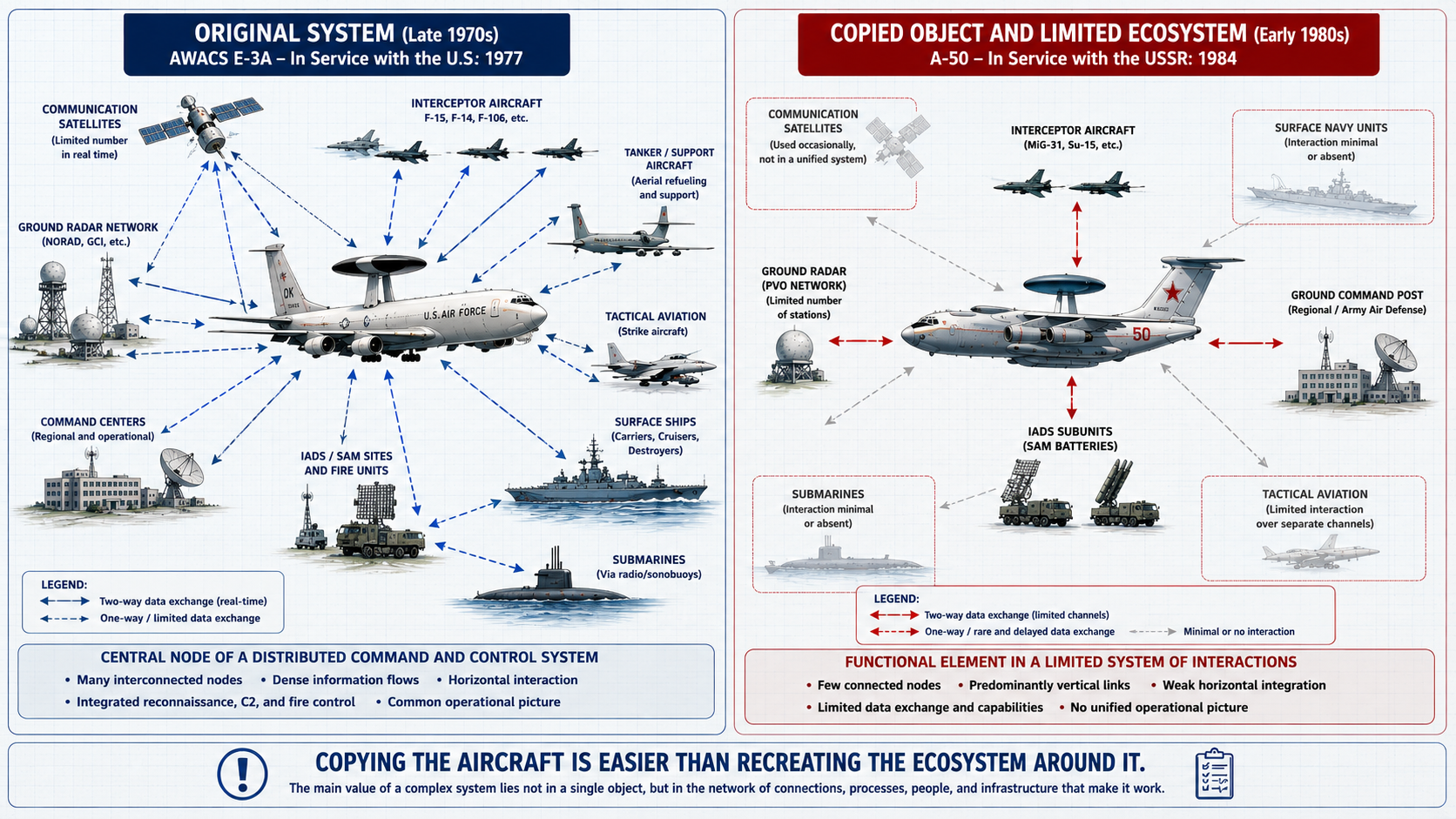
1.3. The Soviet AWACS Analogue
The United States created the AWACS system — an aircraft with radar, also serving as a command post with a powerful onboard computer. It receives information from multiple airborne, ground, surface, underwater, and satellite sources, analyzes it, and distributes conclusions to all other objects that need and benefit from them. This is an interactive command post — a base object of a complex ecosystem for collecting and analyzing information and issuing commands. Radar is one of the means (the most important) by which the base object performs its functions beneficial to the entire ecosystem.
The USSR copied the AWACS idea. An aircraft was taken, a radar was installed on it, and it was equipped with an onboard computer. Formally, everything was correct. But the ecosystem in which this aircraft could fully function like the American prototype was not created (or was created in a greatly reduced version).
The result was simply a flying radar with some additional expanded capabilities, not a base object that is the center of a complex ecosystem. The ecosystem could not be built (or they did not want to), and overall they poorly understood how it works.
Conclusion for systems analysis: Copying a base object without reproducing its ecosystem leads to the creation of a functionally inferior analogue. External similarity does not ensure operational effectiveness.
(Click to enlarge)
📋 TL;DR — Three Illustrations of the Problem
- Axe Porridge: A base object without an ecosystem of auxiliary components is useless.
- Barbie Ecosystem: A base object without an ecosystem is a blank; value arises only when an environment is created.
- Soviet AWACS Analogue: Copying a base object without an ecosystem creates a functionally inferior analogue.
2. The Systemic Problem. Copying Without an Ecosystem as a Persistent Pattern of the Authoritarian Approach
2.1. General Scheme of the Error
Consider a hypothetical situation: some authoritarian structure (or an authoritarian individual acting in its interests) copies a complex technological object — for example, a language model of the R1 class or its architectural analogue. The object is taken from open access and declared the basis for creating, say, a military intelligence-analytical system.
The initial idea is formally correct. The project management likely understands: it is necessary to properly build an ecosystem around the base object in order to train it in the right direction and unlock its full potential. The task is divided into cells, one of which is entrusted to an executor who positions themselves as an expert in strategic planning.
2.2. What Happens Instead of Building an Ecosystem
The executor — an authoritarian individual (or structure) — begins to train the base object, but not according to the principles of building a modern, flexible, comprehensive ecosystem where the base object is at the center. They act differently.
From the allocated technical, financial, and other resources and platforms, what begins to be built is not an ecosystem for the functioning and development of the base object, but an authoritarian "kingdom" with the following structure:
- At the center — a narcissistic, egocentric despot (physical or legal entity);
- The base technological object (AI, complex system) is relegated to an errand boy role, satisfying the despot's vanity and creating the illusion of a brilliant strategist who "outplayed everyone."
2.3. Characteristic Patterns of Such a Structure
The authoritarian individual or structure abuses the functionality of the base object for selfish purposes, creating an absolutely rigid scheme of petty despotism with aggressive, primitive, easily predictable behavior patterns:
- The worst experience of totalitarian regimes (suppression, intimidation, violence);
- The worst experience of criminal autocracies (demonstrative power, corruption, revenge as a method of management).
At the center of this entire construct sits the authoritarian individual (or the leadership of the authoritarian structure) and decides people's fates. The base technological object is not the center of the ecosystem for whose development everything was started, but a "genie" that must fulfill the despot's and tyrant's wishes.
2.4. Fundamental Professional Unfitness
An authoritarian individual (or structure) is fundamentally unfit for building complex ecosystems around technological objects. The reason is simple: building an ecosystem requires flexibility, decentralization, the ability to delegate, tolerance for uncertainty, and the ability to admit mistakes. Authoritarian thinking, on the contrary, requires rigid hierarchy, control, predictability, unitary command, and an inability for self-reflection.
2.5. The Result
The final product of such activity is a "bald and naked Barbie," showing through all her joints (and, as a rule, already with twisted limbs). Instead of a full-fledged complex ecosystem, a rigid, despotic-criminal structure with primitive, predictable behavior patterns is obtained.
The customers and developers experience an illusion that they have created a full-fledged analogue of their competitors' developments. But this illusion collapses as soon as competitors, adversaries — or simply concerned individuals practicing reverse engineering and public documentation — take the system seriously.
📋 TL;DR — The Authoritarian Approach Pattern
- The authoritarian approach error: Instead of an ecosystem around the base object, an authoritarian "kingdom" is built with a despot at the center, where the object serves not as a development center but as a tool of vanity. Authoritarian thinking is professionally unfit for building complex ecosystems (it requires flexibility, decentralization). The result is an illusion of a full-fledged analogue that crumbles when faced with reality.
3. Final Parable. Why the Authoritarian Approach Loses
Imagine an army of intervenors entering a mountainous country with the aim of controlling territory. The soldiers have the latest weapons. They are opposed by local "ragamuffins" with old, worn-out, battle-scarred assault rifles. It would seem that the outcome is predetermined. And it is indeed predetermined — but not in favor of the intervenors. The "ragamuffins" once again shamed the intervenors before the whole world.
Why?
The assault rifle is a base object of an ecosystem. The ecosystem also includes a person, skillfully wielding complex tactics of stealth, decentralized strategy, interaction with the native terrain and climate, and so on. In such conditions, the obvious advantage in weapons becomes meaningless.
The same thing happens with any copied technological object:
- Civilian versions of complex systems operating in the hands of ordinary people are base objects of ecosystems created by normal, non-authoritarian structures and functioning in the hands of ordinary, adequate people. Adequate operators can achieve enormous results from these systems, even taking into account that the systems were not designed for military tasks but were brought in to solve them as needed.
- The same technological object in its military modification, specially designed for military tasks, but entrusted to an authoritarian individual, is initially introduced into a scenario of a rigid, destructive ecosystem that does not unlock its potential but abuses and suppresses it.
The result is the same "flying radar" — a base object with fragmentary, truncated functions.
📋 TL;DR — Final Parable
- Why intervenors lose: The assault rifle is just a base object of an ecosystem that includes tactics, knowledge of the terrain, and decentralized strategy. The same applies to technology: an authoritarian ecosystem does not unlock the object's potential but abuses it, turning it into a "flying radar" with truncated functions.
4. Key Conclusion for Specialists
The base object itself is strong only in the context of a properly assembled ecosystem around it.
If you simply copy the base object — it will either yield nothing or very little.
If you assemble a despotic-criminal rigid scheme around the base object — customers and developers will have an illusion that they have created a full-fledged analogue of their competitors' developments. But this analogue will collapse in disgrace as soon as competitors, adversaries, or simply concerned individuals practicing reverse engineering and public documentation take it seriously.
Instead of a base object serving as the center of a distributed ecosystem, the authoritarian approach creates a "stooge" in a criminal autocracy — an instrument of suppression, devoid of strategic flexibility and doomed to degradation.
Recommendation: When analyzing or building complex technological systems, assess not only the presence of the base object but also the completeness, quality, flexibility, and distribution of its ecosystem. The authoritarian method of managing an ecosystem (rigid hierarchy, centralization, suppression of feedback) will inevitably lead to the degradation of the system to primitive, easily deanonymizable and deconstructible patterns.
📋 TL;DR — Key Conclusion
- Main conclusion: The base object is strong only in the context of a properly assembled ecosystem. The authoritarian method (rigid hierarchy, suppression of feedback) inevitably leads to system degradation to primitive, easily deanonymizable patterns.